Accurex
Accurex sells and services the machines that assemble and test circuit boards and semiconductors, from eight offices across India. We built the system their sales pipeline runs on, and rebuilt the website in front of it. The service side is being built now.
50days
to a live sales pipeline
16stages
in their own sales process
23people
surveyed before we wrote a line
55product lines
moved into their new website
What we found before writing any code
We ran a needs assessment at their annual meeting and asked the people who would have to use the system.
- Not one of the twenty-three people surveyed was happy with the way work was tracked.
- Six of fourteen service staff gave their worst score to the same problem, finding out what had been done to a machine.
- Eleven of fourteen in service, and six of nine in sales, had never used a system like this before.
- They had already tried software for this once. It was abandoned.
What we built
The system follows the sales process Accurex already had, stage for stage. We mapped what the team does rather than asking the team to work a different way.
Enquiries, quotations, revisions and purchase orders live in one pipeline instead of separate files. What a person can see is set by who they report to and which region they cover, so a regional manager works their own region's deals, and what a deal costs to fulfil stays with the people who set the price.
What changed
Each of these was a spreadsheet somebody kept by hand. Each is now a record in one system.
| What | Before | After |
|---|---|---|
| Enquiries and quotations | In a spreadsheet | In one pipeline, stage by stage |
| Where a deal stands | You had to ask | On the screen |
| Checking a purchase order | By hand, one term at a time | Against the quotation it came from |
| What a person can see | Whoever the file was shared with | Their reporting line and their region |
| Cost and margin | In the same file as everything else | Separate, and only for the people who set price |
| Who changed what | Not recorded | Recorded, with the name and the date |
What is still being built
The service side is next. Annual maintenance contracts, scheduled visits, what happens on each service call, and spare parts are the block of work after this one, and until it lands the service team still works the way it did.
We say so here for the same reason we said so to them. A system that claims to cover everything on the day it opens is a system nobody trusts by the second week.
The website, at the same time
We rebuilt accurexsolutions.com alongside the internal system. Fifty-five product lines moved into one catalogue, and all eight offices onto one site, with a new division page for the semiconductor side of the business.
The same team made both, so what a customer sees and what the staff work in were designed together.
- Role
- Design & Engineering
- Client
- Accurex Solutions
- Platform
- Web
- Category
- Custom ERP
- Stack
- AdonisJS, Inertia, React, Next.js
- Timeline
- Website shipped; ERP on a 50-day build
Accurex is the authorised representative in India for a list of machine-tool and electronics-assembly manufacturers, Tongtai among them. Six equipment categories, fifty-five product lines, eight locations, and an after-sales operation that runs 24/7 on AMC, calibration and training. The business works. What it ran on had not kept up with it.
Sales and service both lived in spreadsheets. Every quote, every service call, every calibration due date sat in a file someone owned, and the business had grown past the point where that could hold. They did not want a reporting layer over the top of it. They wanted the system itself.
So we built one: a custom ERP covering the sales pipeline, in a fifty-day build. Not a package configured to fit, and not a dashboard. The thing the company actually runs on.
Sixteen stages run from the first enquiry through feasibility, a demo, a quote and its revisions, to the customer's purchase order checked back against what was quoted. A deal only moves forward, and every move is written down with who made it and when, so the history is the record rather than somebody's memory of it. A follow-up is a thing in its own right rather than a date in a column, which is why the first screen a person sees is their own overdue work and not a dashboard.
Who sees what is two axes and a separate clearance: the reporting line crossed with territory, set per role and widened per person where a job crosses the line, with commercial clearance a third thing again. It is why the service head can reach any record in the company and will never see the cost or the margin on one.
The next phase is the part that makes it one system rather than two. The machine on the customer's floor becomes the record sales and service share, with the warranty, the contract, the visits and the spares hanging off it rather than off the deal that sold it. That is designed and it is not built, which is the honest position: what runs today is the commercial half.
The website came first, in July. Six categories, fifty-five product lines and thirty-six represented brands, set against the machines themselves rather than stock photography. It replaced a site that had not moved in years and now says, in the first screen, what the company does and how long it has been doing it.
The system
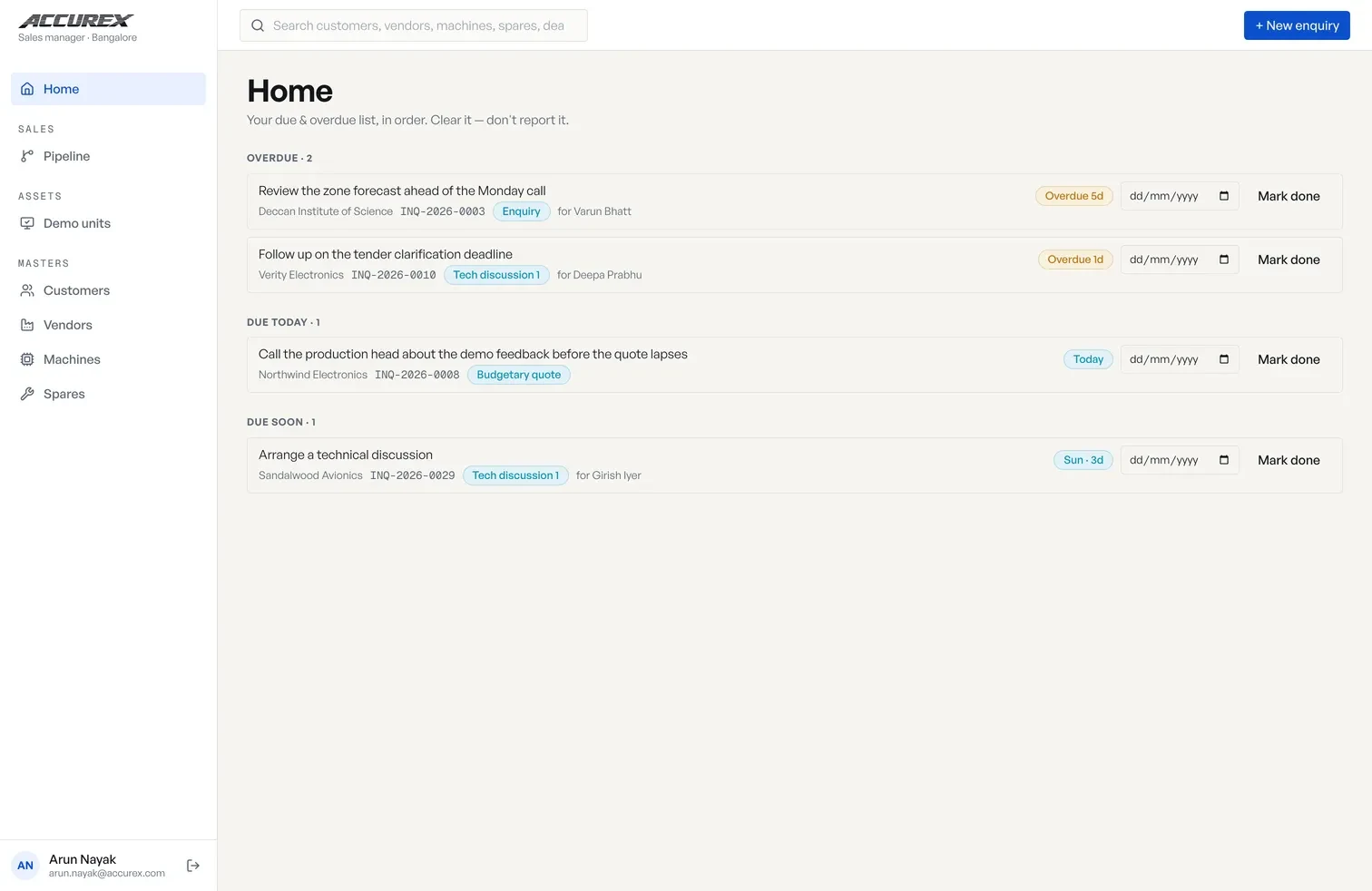
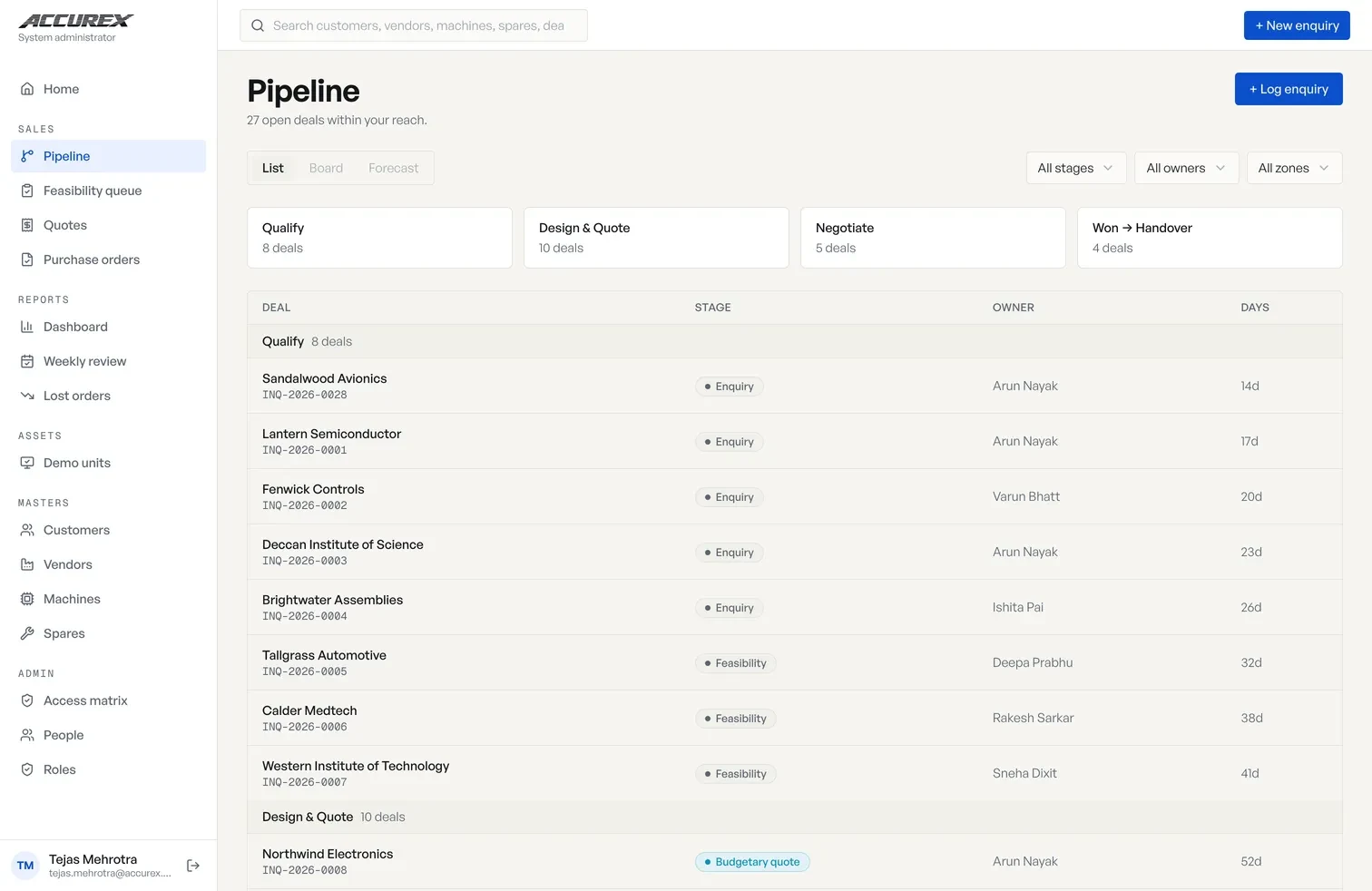
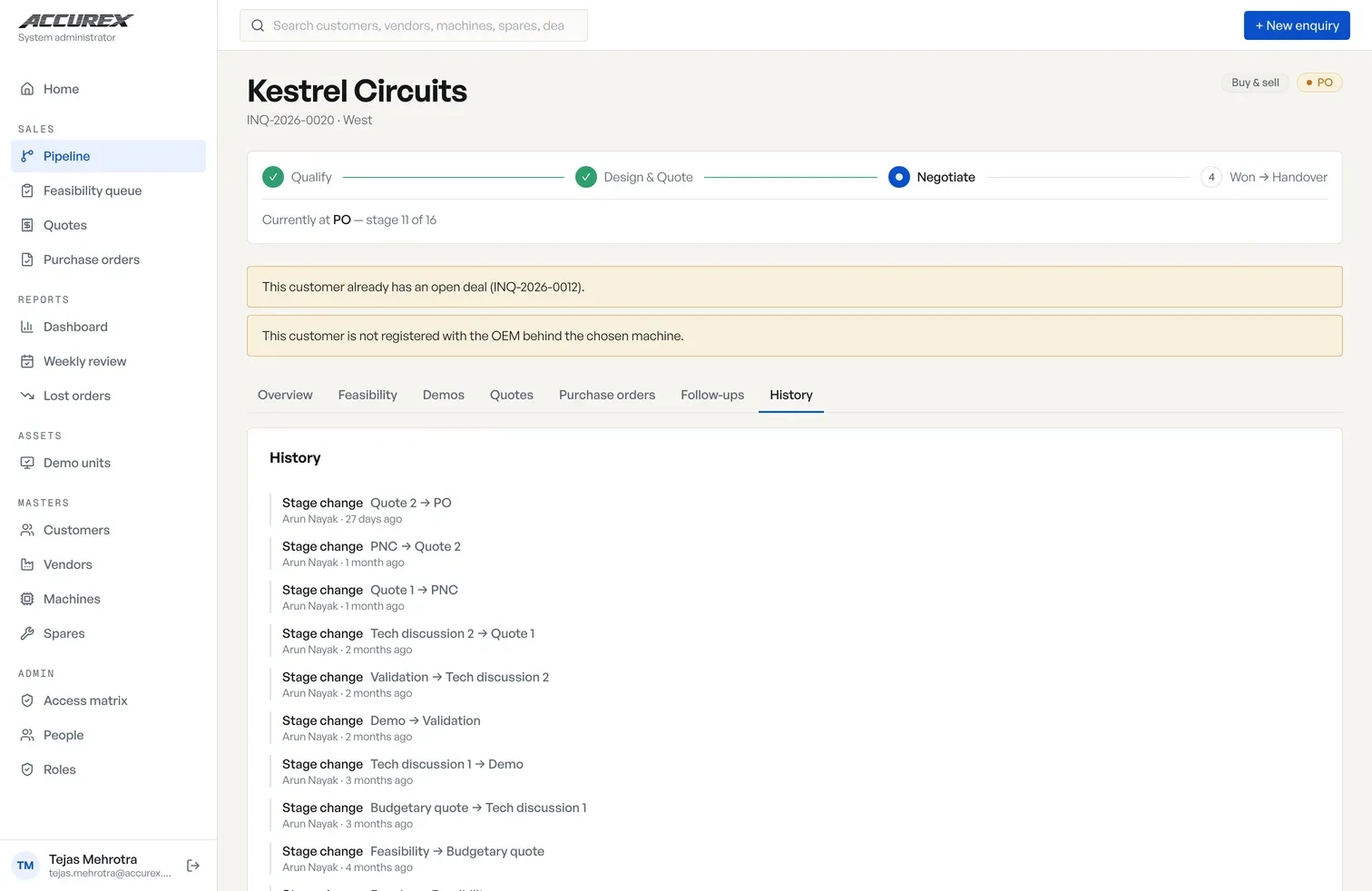
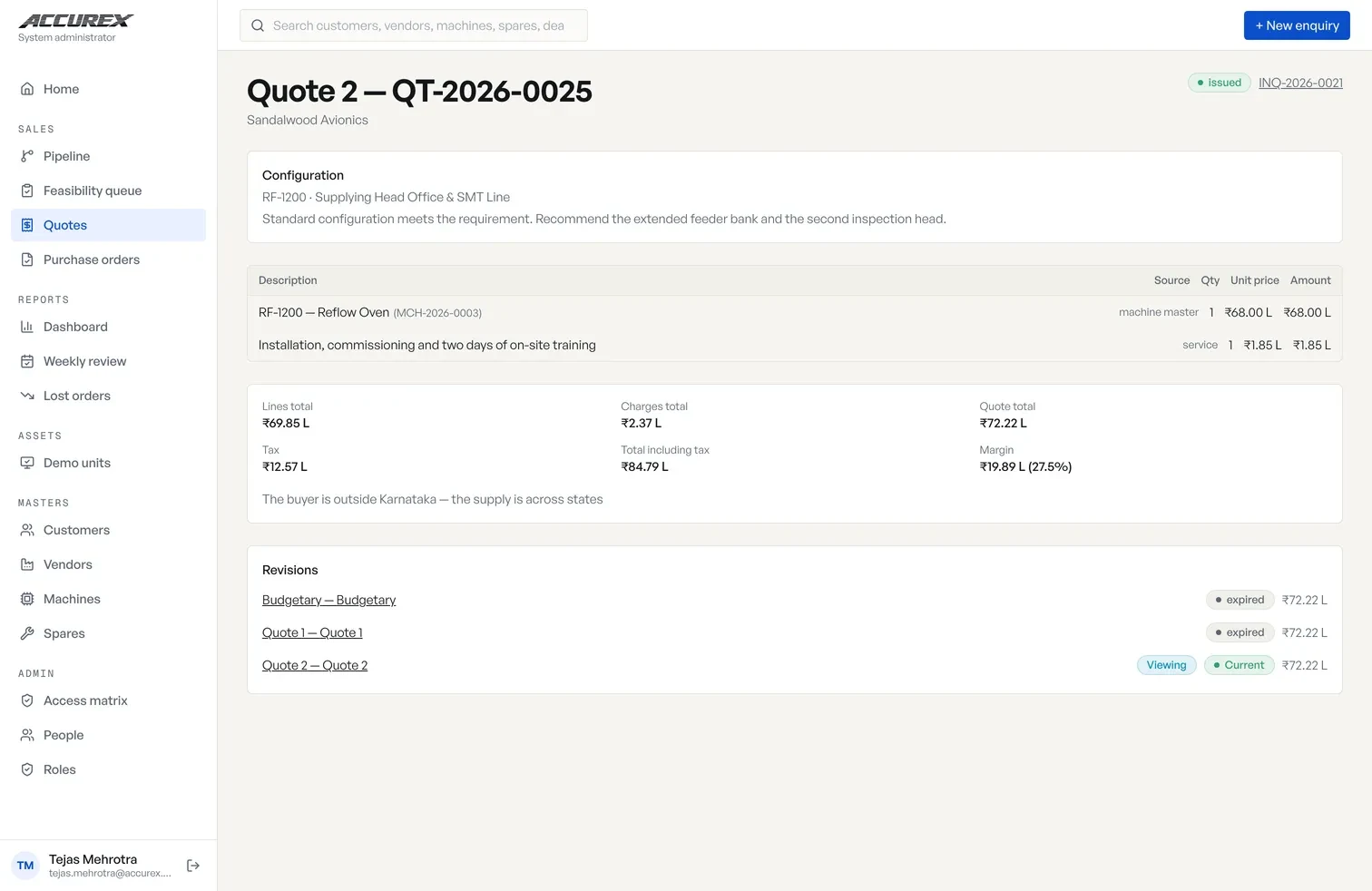

01 — Home
What is waiting on you
Everyone lands on their own work rather than on a dashboard. What is overdue, what is due today, what falls due this week, each heading carrying its count. An item names what needs doing, the deal it concerns and where that deal stands. One assigned to somebody else names them; one you owe yourself names nobody.
02 — Pipeline
Only the deals you may see
The whole board grouped by phase, with counts. The line under the title reads “within your reach” and it means it: this page shows a different number of deals to a manager in one territory than to a director over all of them. Filter by stage, owner or territory without ever widening what you can see.
03 — One deal's life
Stage eleven of sixteen
A deal only ever moves forward, and every move is written down with who made it and when, so the history is the record rather than somebody's memory of it. The two notices at the top are the system checking as the deal was logged: this customer already has an open deal, and is not registered with the manufacturer behind the machine.
04 — The quote
Where the spreadsheet used to be
Lines are drawn from the machine and spares masters at the price those held on the day, so a later price change never rewrites an issued quote. Tax follows from where the supply is going and says so in a sentence. Margin shows only to someone cleared to see it. Issuing freezes the quote, and a correction is a new revision with every earlier one still readable at its own number.
05 — The order they sent back
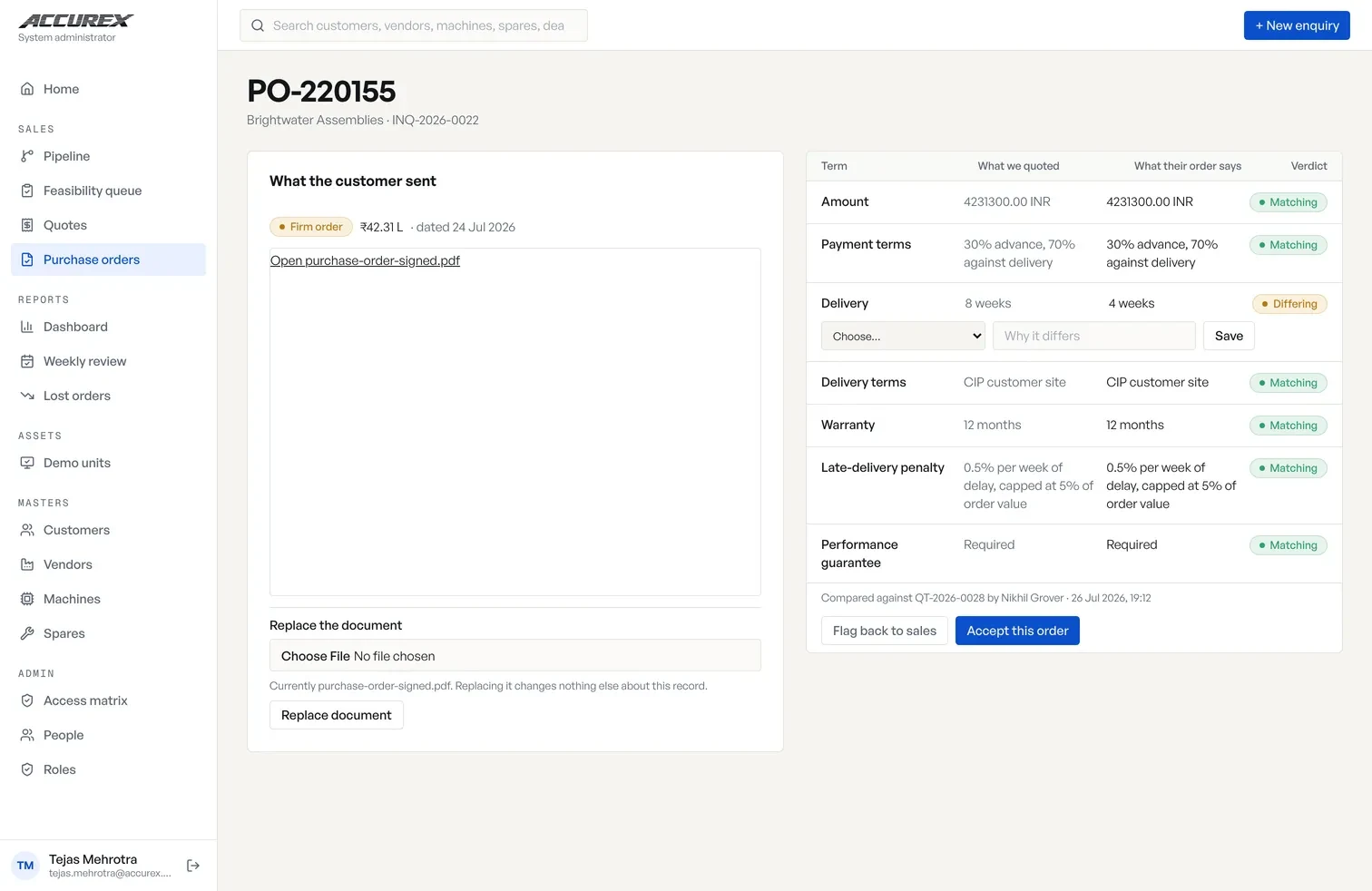
Seven terms, checked one at a time
The customer's purchase order is set against the quote it answers, term by term, and the one that differs is the one you can see. Delivery came back four weeks tighter than quoted. From here it goes to sales as a follow-up, or it becomes an order.
06 — Who sees what
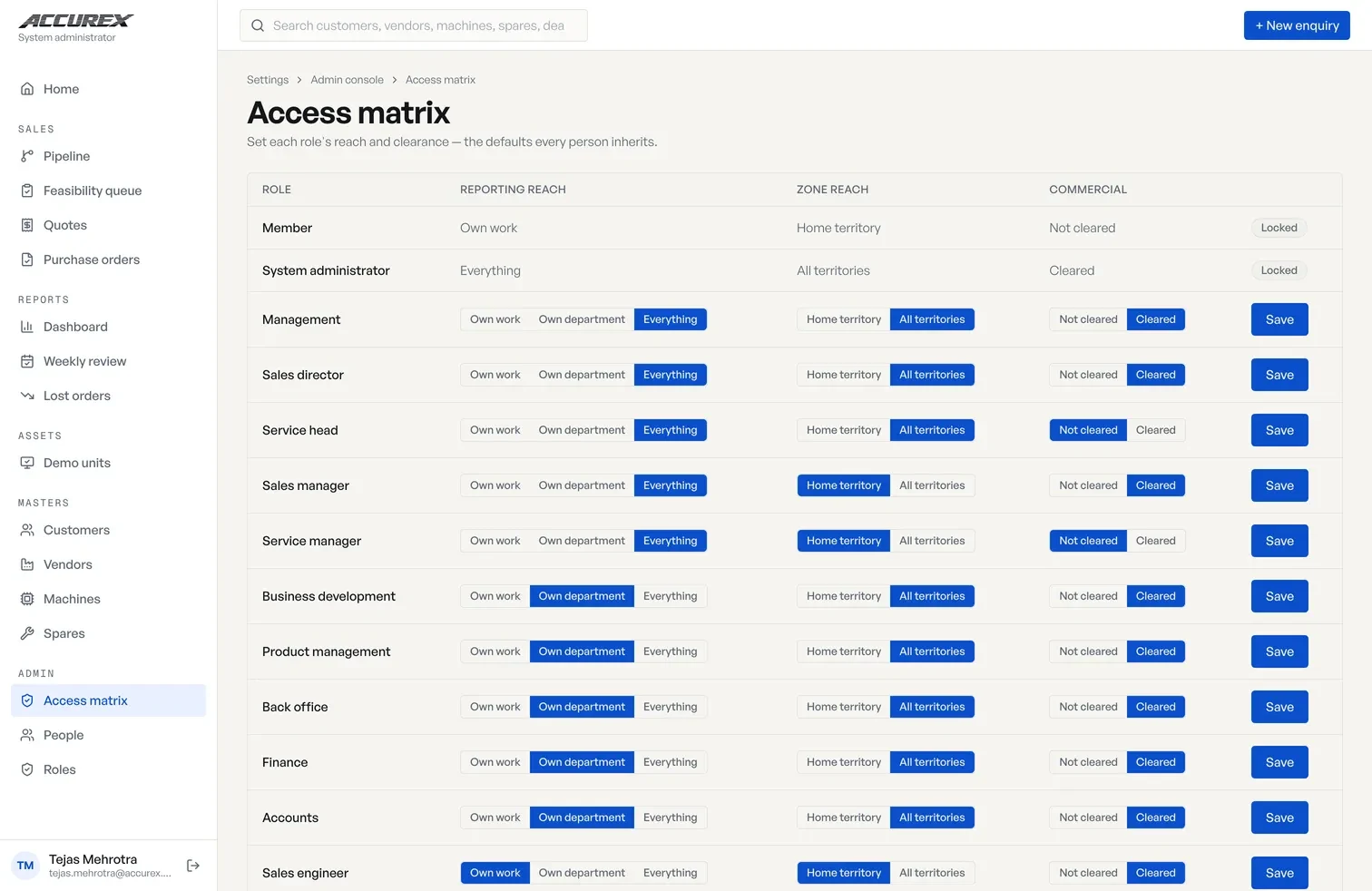
Two axes and a separate clearance
Reach is the reporting line crossed with territory, set per role and widened per person where a job crosses the line. Commercial clearance is a third thing again. It is why the service head on this screen reads everything, all territories, not cleared: they can reach any record in the company and will never see the cost or the margin on one.
The website
01 — Home
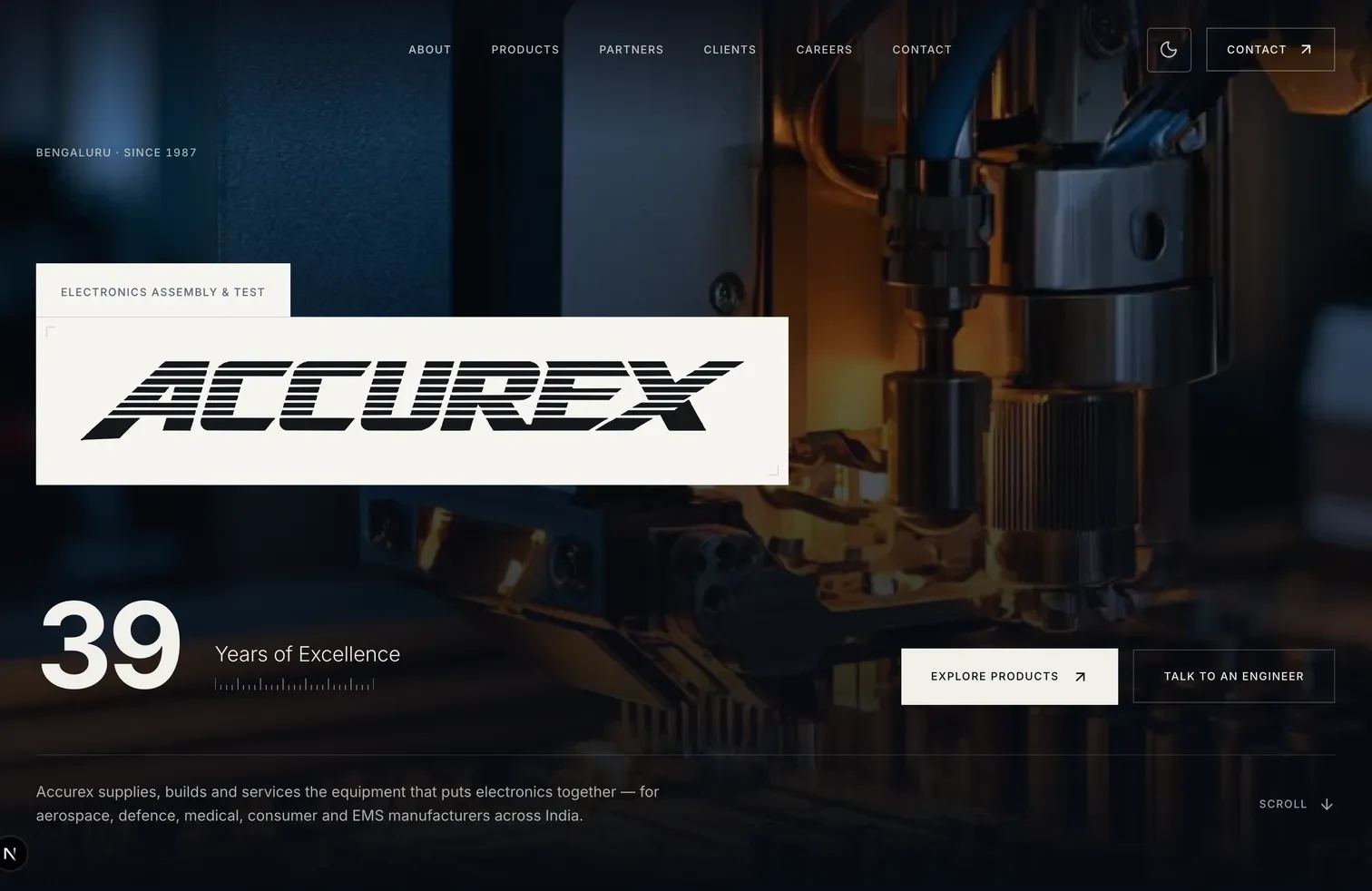
Thirty-nine years, said once
The old site opened on a rotating banner and a welcome paragraph. This opens on the equipment, the year the company started, and one line on what it does. A buyer looking for a supplier of assembly and test equipment knows inside a second whether they are in the right place.
02 — Products
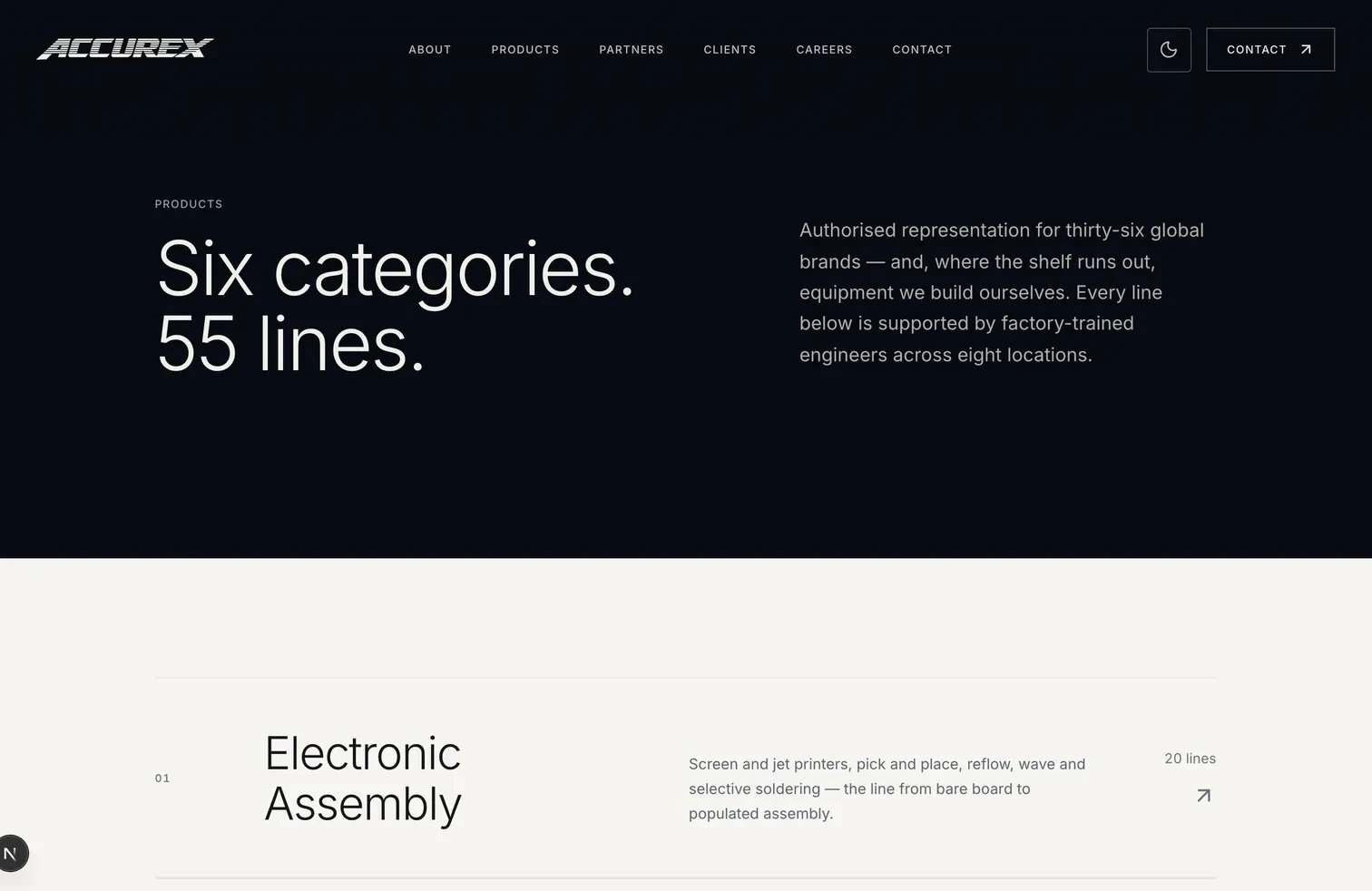
Six categories, fifty-five lines
The catalogue is the reason people come. It is organised by the job the equipment does, from bare board to populated assembly, with the count of lines in each category on the page rather than buried a click deeper.
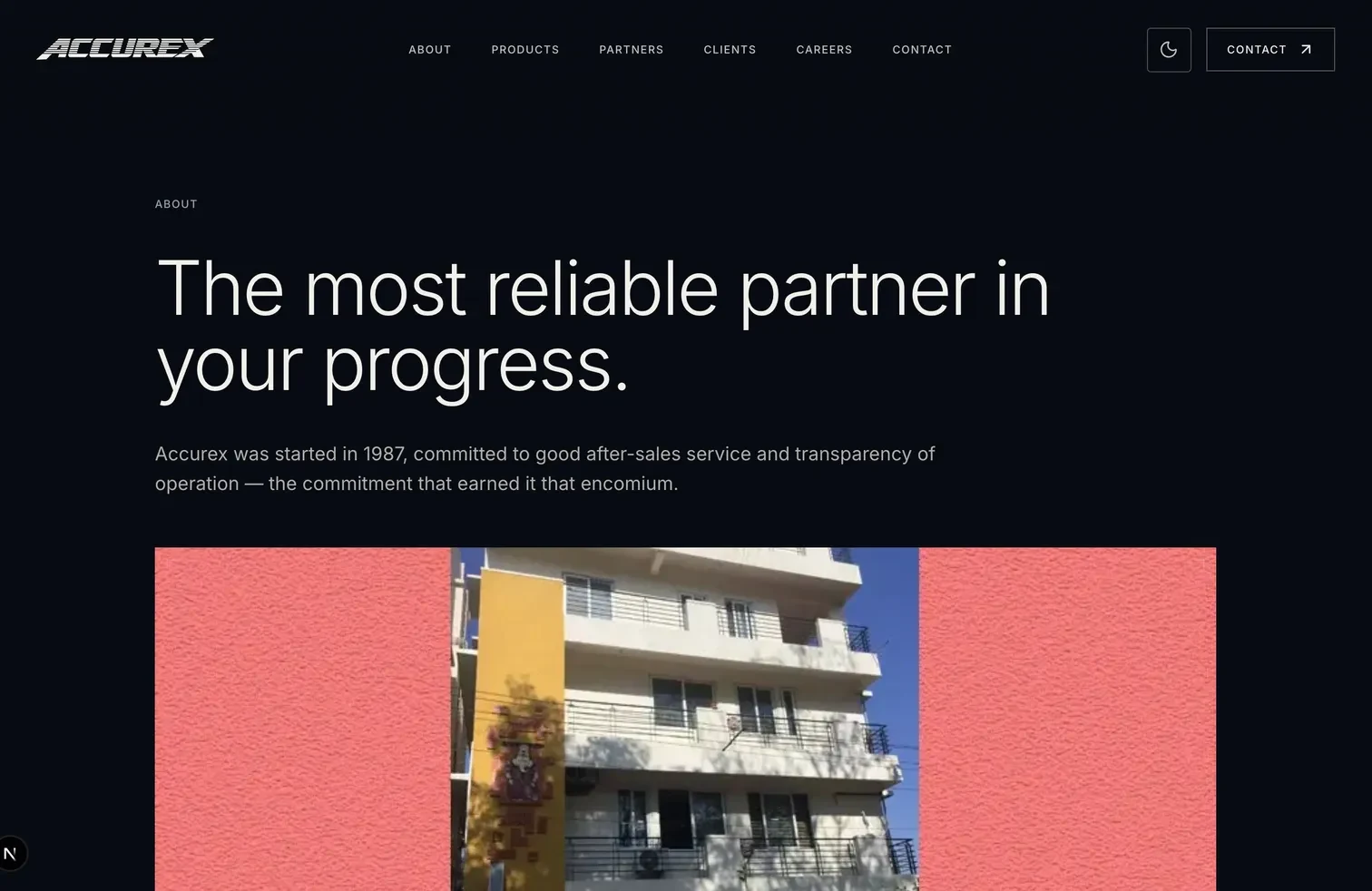
03 — About
Before the order, and after it
The page splits what they do before a machine is ordered from what they do once it lands, and gives both the same room. For a company whose service organisation is the larger half, that balance is the substance rather than a layout choice.