Enmovil
Enmovil builds software that moves freight. The date could not move either, so the site went up in the week before it. Four months on we are still committing to the same repository.
1week
to build the whole public site
4months
of continued delivery after launch
What we built
Everything a visitor sees. The site explains a platform that is hard to explain, so the work was as much about what to say as how it looked, and it went up as one piece rather than a homepage with the rest to follow.
It runs on a content system their own team edits. That was the point of building it that way: a company that has to call its agency to change a line of copy stops changing lines of copy.
What changed
The event was the deadline. These are the things that had to be true by the morning it opened.
| What | Before | After |
|---|---|---|
| Somewhere to send a prospect | Nothing worth sending | A site that explains the product |
| Changing a page | No page to change | Their own team, without calling us |
| Who the site is for | Undecided | Written for the people at the stand |
What happened after the deadline
Most launch stories end at the launch. This one did not. There are changes from this month in the repository the site runs from, and they are ours and theirs in the same history rather than ours handed over and theirs afterwards.
The recent work is unglamorous and worth naming for that reason: language support, and a mail relay that had been failing quietly. A site is not finished on the day it goes up.
- Role
- Design & Development
- Timeline
- 1 week, April 2026
- Platform
- Web
- Stack
- Next.js, Payload CMS
- Client
- Enmovil
- Status
- Live at enmovil.ai
Enmovil is an AI-native platform for autonomous supply chain and logistics. Demand forecasting, dispatch planning, 3D load building, control tower, ETA, electronic proof of delivery, freight settlement, all routed through their reasoning engine, CADDIE.
They came to us with a clear brief and a hard deadline. They needed a public presence that read as seriously as the platform itself, and they needed it before a major industry event. We designed and built the whole site in a week, April 1 to April 6, then handed their team the infrastructure to keep it growing.
What we shipped
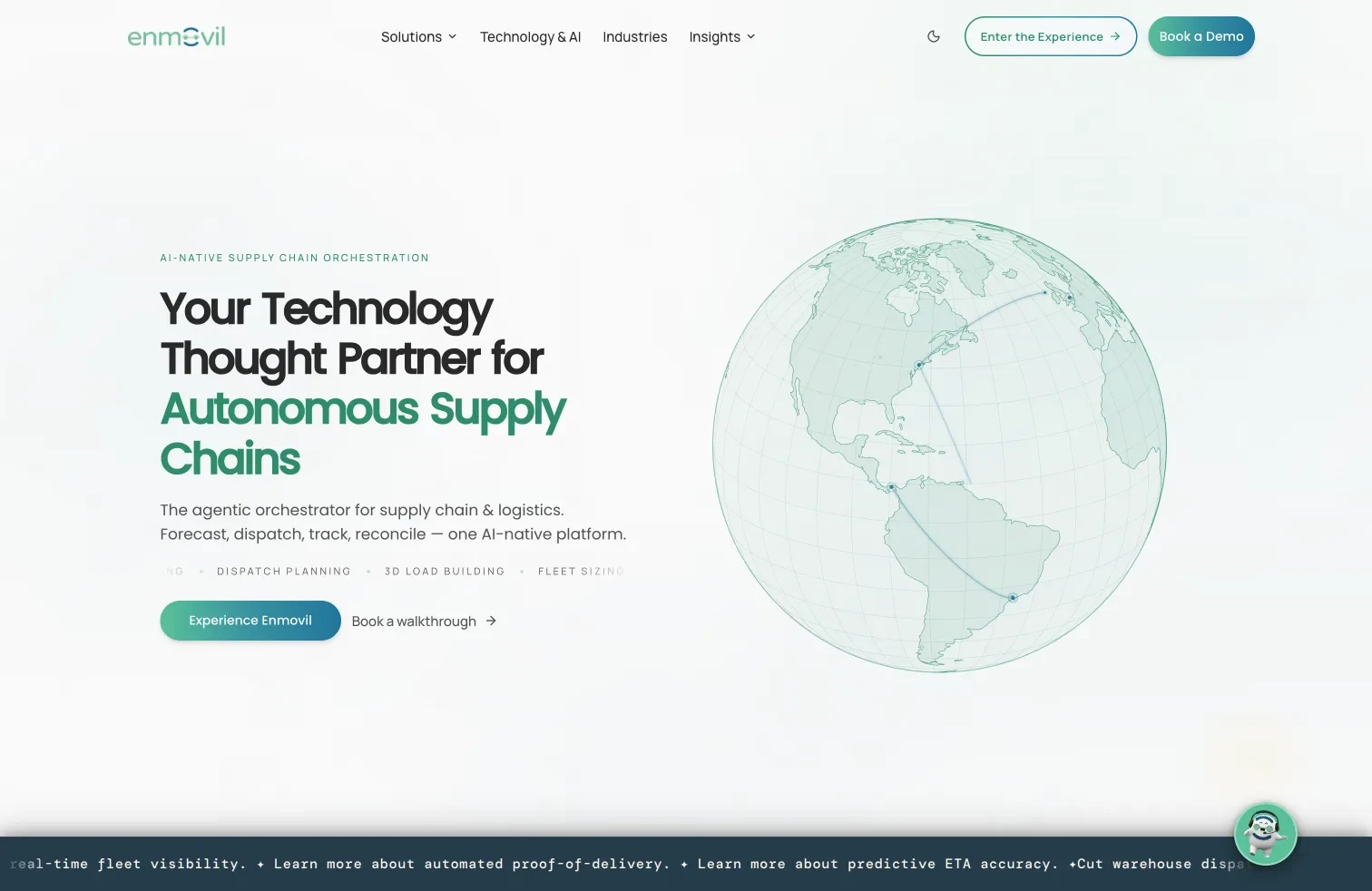
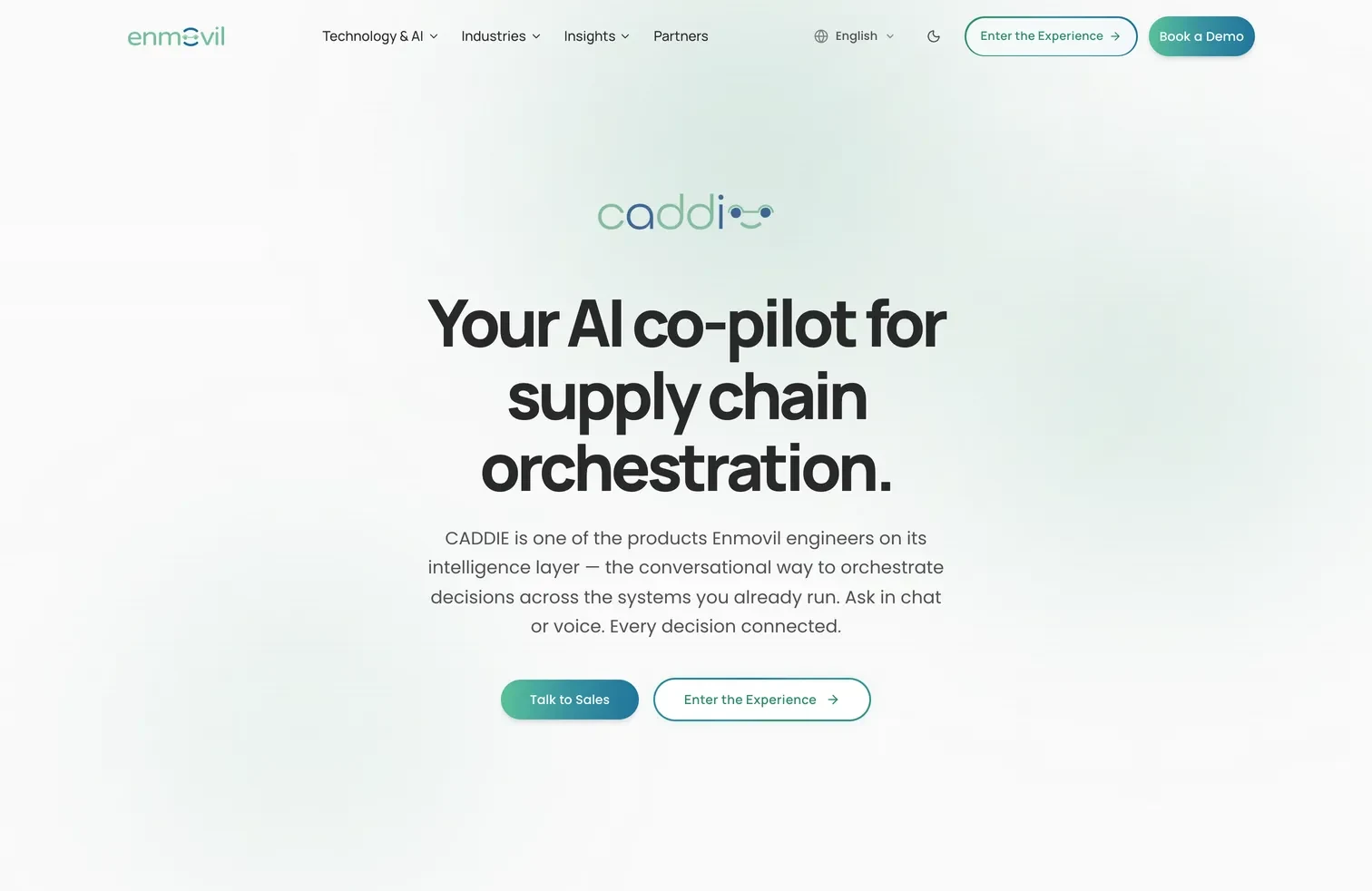
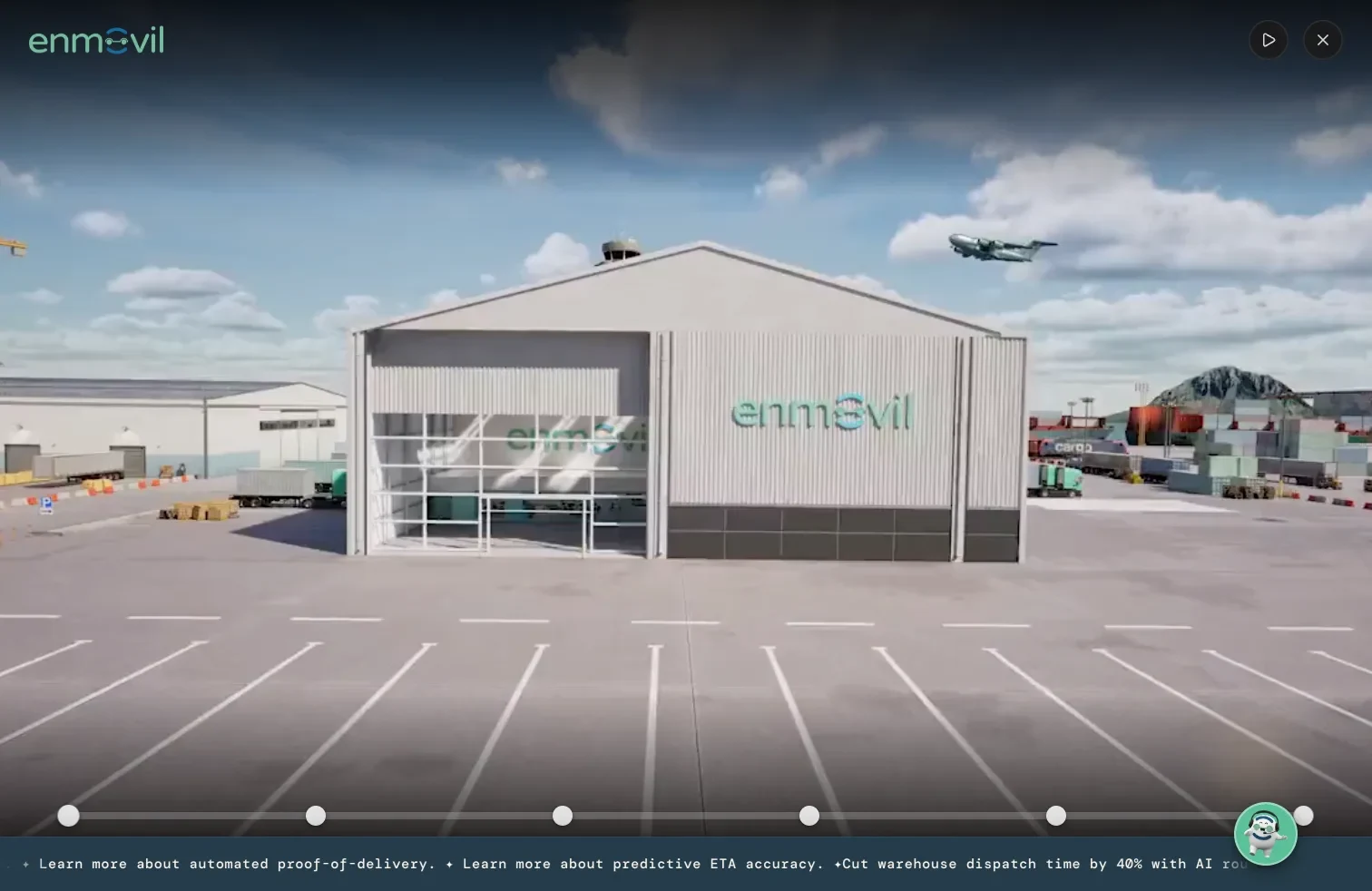
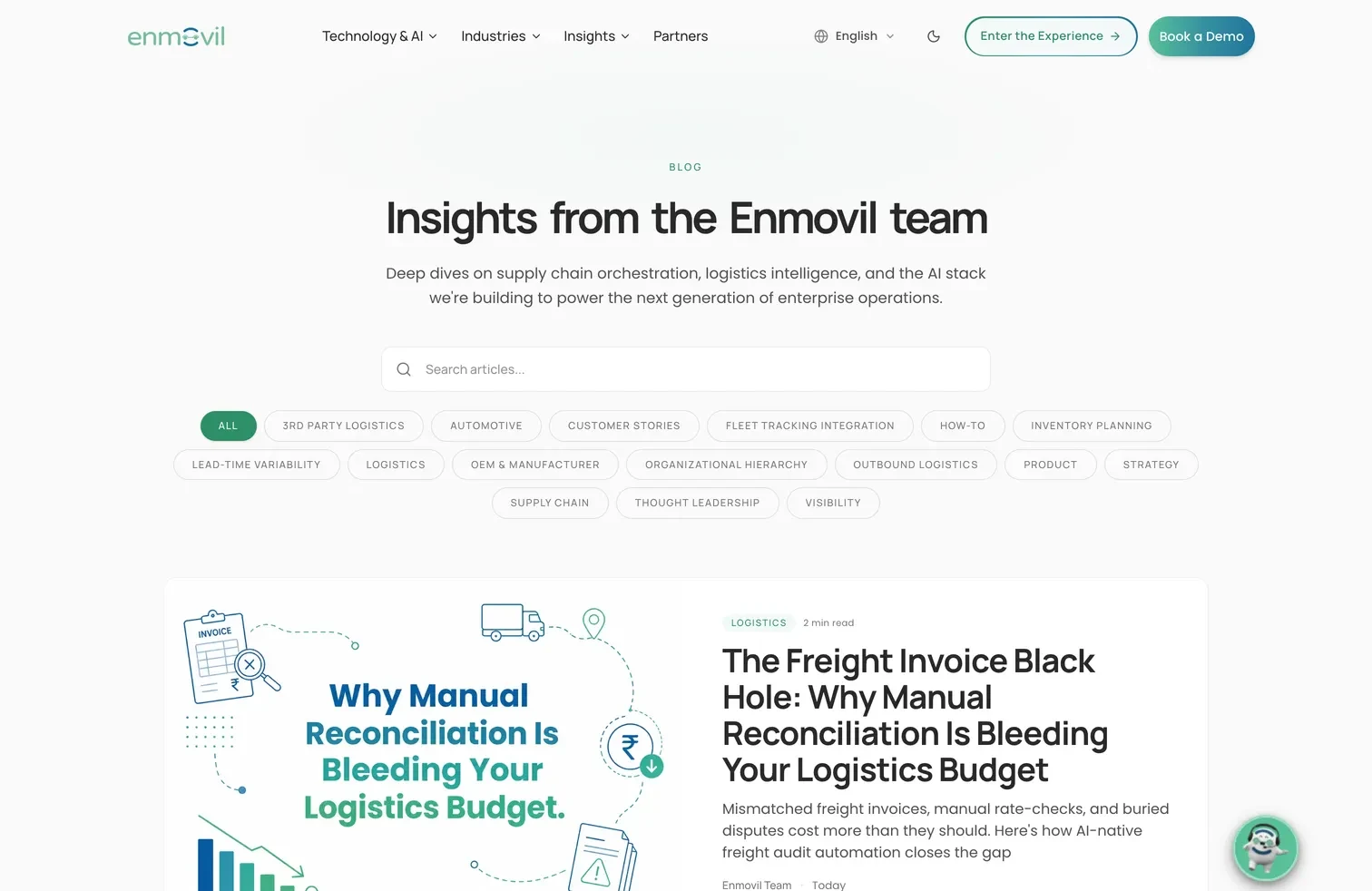
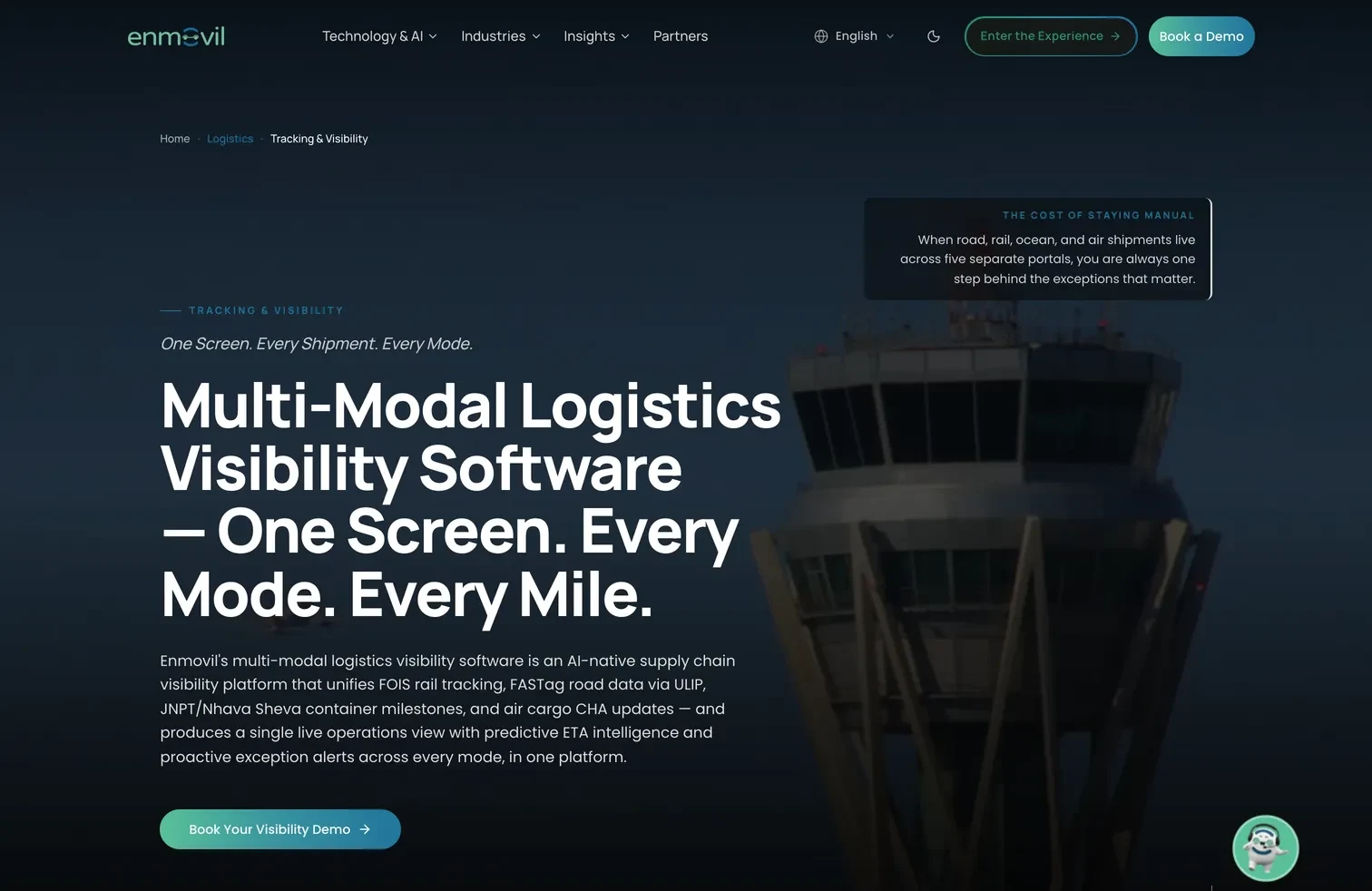

01 — Launch
Their whole presence, online in a week
Enmovil needed to look as serious as the platform behind it, and they needed it before a major industry event. We designed and built the full site in seven days, April 1 to April 6, and it has been theirs to run since.
02 — CADDIE
The engine, given its own room
CADDIE is the reasoning layer the rest of the platform sits on, so it got a page of its own rather than a paragraph on someone else's. One colour is reserved for it across the whole site, which is how a reader learns where it starts and stops.
03 — The experience
A scroll you can leave running
We built the product story as an immersive, scroll-driven experience with its own interface. It runs on autoplay end to end, which is exactly how it ran at their stand: nobody had to drive it.
04 — Their words, not ours
The team publishes without calling us
Insights runs on the Payload CMS underneath the site. Their team writes, tags and schedules the articles themselves, with drafts that autosave and SEO fields on every entry. The piece at the top of that page went up on their own, months after we handed it over.
05 — Two registers, one system
Dark where the work is
The control-tower pages run dark and the marketing pages run light, on one set of tokens. It is the same site in both, which is what lets a capability page feel like the product rather than a brochure about it.
What we built
The marketing site
The homepage with its live logistics globe, plus the product and solution pages: Technology & AI, Supply Chain, Logistics, Industries, CADDIE, About. Built modular, so each capability tells its own story without forking the codebase.
Insights and case studies
A Payload CMS hands the Enmovil team a block library to compose pages themselves. They publish thought leadership and customer stories on their own, with autosaving drafts, scheduled publishing, and SEO fields built into every entry.
The Experience
An immersive, scroll-driven product experience at /experience. It runs on autoplay end to end, which is exactly how it ran at their stand: no one had to drive it.
The site runs on Next.js with the App Router and React, styled in Tailwind. Motion is handled with Framer Motion, GSAP, and Lenis for smooth scroll. The hero globe is drawn live with d3-geo, vehicles tracing great-circle routes across an orthographic projection.
Content lives in Payload CMS on Postgres, with media on Vercel Blob and a Lexical rich-text editor. Around sixteen layout blocks let the team build pages without us. Drafts autosave, posts can be scheduled to publish, and an SEO plugin handles meta and Open Graph per entry.
The routing can support nineteen locales through next-intl, with structured data, a generated sitemap, and per-page metadata so search engines read it correctly. It is hosted on Vercel. All of it stood up in a week.
The type system pairs a geometric grotesque with a humanist sans. Manrope carries the display weights, tightened for the big claims. Poppins handles body copy at a comfortable measure. JetBrains Mono appears where data and code want a monospace.
- ManropeDisplay & headings
- PoppinsBody
- JetBrains MonoData & code
The palette runs cool and technical. A bright green leads, deepened for text and illustration where contrast demands it, and supported by teal and blue. CADDIE, the reasoning engine, gets its own purple so it reads as the thing underneath everything.
- GreenPrimary. CTAs and accents, and the signature green-to-blue scrollbar.#59C098
- Green, accessibleDarkened green for text and icons on light surfaces (WCAG AA).#2D8C6A
- TealSecondary accent.#37919F
- BlueTertiary accent and gradient depth.#20749B
- CADDIEReserved for the reasoning engine.#7030A0
- InkDark surfaces and the cinematic sections.#131313